

When you first open your new Braun, Panasonic, Philips, or Remington shaver be sure to charge the shaver for a minimum of 8 hours, or overnight. This ensures that the battery is fully charged before the first use. Almost all manufacturers use Li-Ion batteries that do not develop a memory and cannot be over charged. This does not apply to cord model shavers or battery travel shavers.
It is best to clean your shaver after every shave.
On Braun, Remington or Panasonic foil shavers you can lift off the head frame, which holds the screen, and gently brush out the whiskers from the under side with the cleaning brush the manufacturer usually supplies. Do not touch the screen itself with the cleaning brush. It is very fragile.
Below the screen is the cutter and that is the part you need to brush out. Get all the accumulated whiskers out of the cutter, so that it can properly do what it's supposed to do: Cut your beard! Whisker residue built up on the cutters can prevent you from getting a good shave.
For Philips rotary head shavers, lift off the razor head assembly and brush out the under side of the three cutters and the razor chamber. Do not tap heads on the sink to remove whiskers. This may dent or damage the precision-made combs. Every other month (or more if necessary) remove each of the cutters and combs from the retaining plate, keeping each set as a matched pair. Brush whiskers from the cutters and soak in liquid cleaner and lubricate.
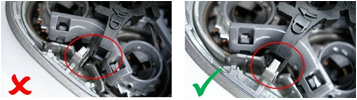 Retainer Plate - Head Frame
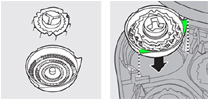 Philips Cutting Head Diagram
Most Philips shavers have a similar head assembly except the Arcitec, Sensotouch, Sensotouch 3D and some Coolskin models.
For wet/dry or washable models you can clean the shaver by opening the head frame or removing the shaving foil, and rinsing the shaver under the tap. Leave the shaving foil off and the head frame open for the shaver to air-dry.
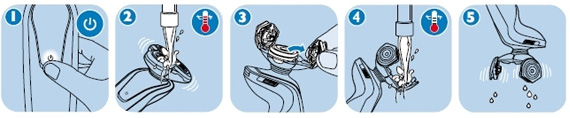 Wet/Dry Washable Cleaning
Braun, Philips and Panasonic also make self-cleaning models. You simply place the shaver in the cleaning centre, and it is automatically cleaned, and charged at the same time. This way you always have a clean, fully charged shaver in the morning, with no work and no mess. The cleaning solution also includes a lubricant for the cutters, ensuring they stay sharp as long as possible.
 Self Cleaning Routine
After you clean your shaver, it is important to lubricate the metal surfaces of your screen and cutter. Spray a product such as Remington's "Shaver Saver" on the shaving screen while the shaver is running. This immediately frees up any metal against metal binding. Use this lubricant sparingly. No need to wipe it off. Proceed with your shaving. You will notice a pick up in the sound level of the shaver motor which tells you that it is then operating at its maximum power level.
To get a good close shave, you must first start with a smooth screen and a sharp cutter. Over a period of time, usually one year, the screen will become thin and wear through. The cutter will become dull. For best results, we recommend that you replace these parts annually during the life of the shaver. If you don't, you're inclined to press harder to get a closer shave, or you may go over the same area of your face repeatedly. Either of these actions usually will result in irritated skin.
The most common question we hear is "Should I buy a foil shaver or a rotary shaver?" The short answer is: buy the one that works best for you. If you have never had an electric shaver before, or are unhappy with your current one, almost all models come with a money back guarantee. Rotary shavers like Philips and Remington may be better for people with uneven skin, or anyone on blood thinning medication, because they have a thicker outer foil than foil shavers. Foil shavers like Braun, Panasonic and Remington may be able to give a slightly closer shave due to their thinner outer foil, but they are more delicate. If you have very sensitive skin, you may want to consider a wet/dry model. Braun, Philips, and Panasonic make wet/dry models. You can use shaving gel or cream with these shavers, as well as shave in the shower, to minimize irritation.
One good piece of advice is to shower before shaving, it helps to soften your beard. Softening your beard hairs does not just apply if you shave with a manual razor and shaving cream, electric shaving can also be improved if the beard is softer. To do this wash the beard with warm water, soak it with a hot wash cloth, pat it dry thoroughly and dust with talcum powder.
If this is not possible, splash on an alcohol based pre-shave. This will remove skin oil and make the beard stand out from your face as much as possible. If alcohol is an irritant for you, we have a powder stick that will give similar results. If using a pre-shave lotion, wash your hands before picking up the razor. Pre-shave lotion can loosen the glue that holds the decorative discs on the Philishaver's shaving head. Lotion on the hands can cause the razor housing to bubble over a period of time. After shaving apply lotion to the skin, this helps keep the skin moist.
Gently rub your fingers over your face to find out what direction your beard is growing. It may vary from one part of your face to another. Now pull the skin gently with one hand, while dragging the shaver against the direction of growth with your other hand. This will give you the closest shave. In the case of a rotary-type shaver like Philips, make small circular motions of the shaver head on your face. Remember not to press hard or go over the same spot repeatedly.
Many men who have very sensitive skin report that it helps them to shave the most tender areas of their face (the neck area below the jawbone) first, and then move up to the tougher areas of their face in the areas between the ears, nose and mouth. Some shavers generate heat on their shaving surfaces and heat can cause irritation, so shave the tender areas of your face first while the shaver head is coolest.
Some customers have a problem with in-grown hair. This may result from abrasions on the skin that have healed and scabbed over the follicle. In other instances, a dull cutter may shred curly hair follicles causing them to snag surface of the skin and grow inward. In either case, what is required is a fine hair trimmer to cut the hair to the skin, then a foil to shave you close.
If ingrown hair and razor bumps are a frequent problem for you, it may not be the best advice to shave against the direction of hair growth. Some dermatologists believe that shaving against the hair growth is not a great idea. You may be actually getting a shave that is too close and prone to ingrown hairs. If you are using an electric razor that lifts the hair before it cuts it, the tip may actually become embedded under the surface of the skin when your hair springs back into place, which may lead to ingrown hairs. This, however, is not a common problem.
If you have been using a different brand of electric shaver than the one you are switching over to, please allow for some break in time. Although most shavers have somewhat similar shaving principles, their "in use" applications differ. Give yourself a week or two for your face to adjust to the new shaver.
If you have been using a blade razor, then you must give your face a minimum of two to three weeks to adjust to electric shaving. Why? Well, every time you shave with a razor you actually take off a very thin layer of skin. With electric shaving, you are shaving at or below the skin line, without actually shaving the skin. So, you need this two to three weeks adjustment time to get rid of the replacement scar tissue that the body produces after every razor blade shave. You do not produce this scar tissue with electric shaving. Do not fluctuate back and forth between blade shaving and electric shaving if you want to achieve the many benefits of electric shaving. Be determined and stick with your decision to use an electric shaver.
Philips and Braun offer a money-back guarantee for all men's shavers. If you cannot get used to the shaver even after several shaves, the shavers can be sent back to the manufacturers for a full refund.
Remember to keep your shaver clean and lubricated, replace the screen and cutter when necessary, use a light touch, and stay with it!